

Baytril 2.5% Oral Solution for Pet Birds & Small Animals – Enrofloxacin 25 mg/mL – 25 mL
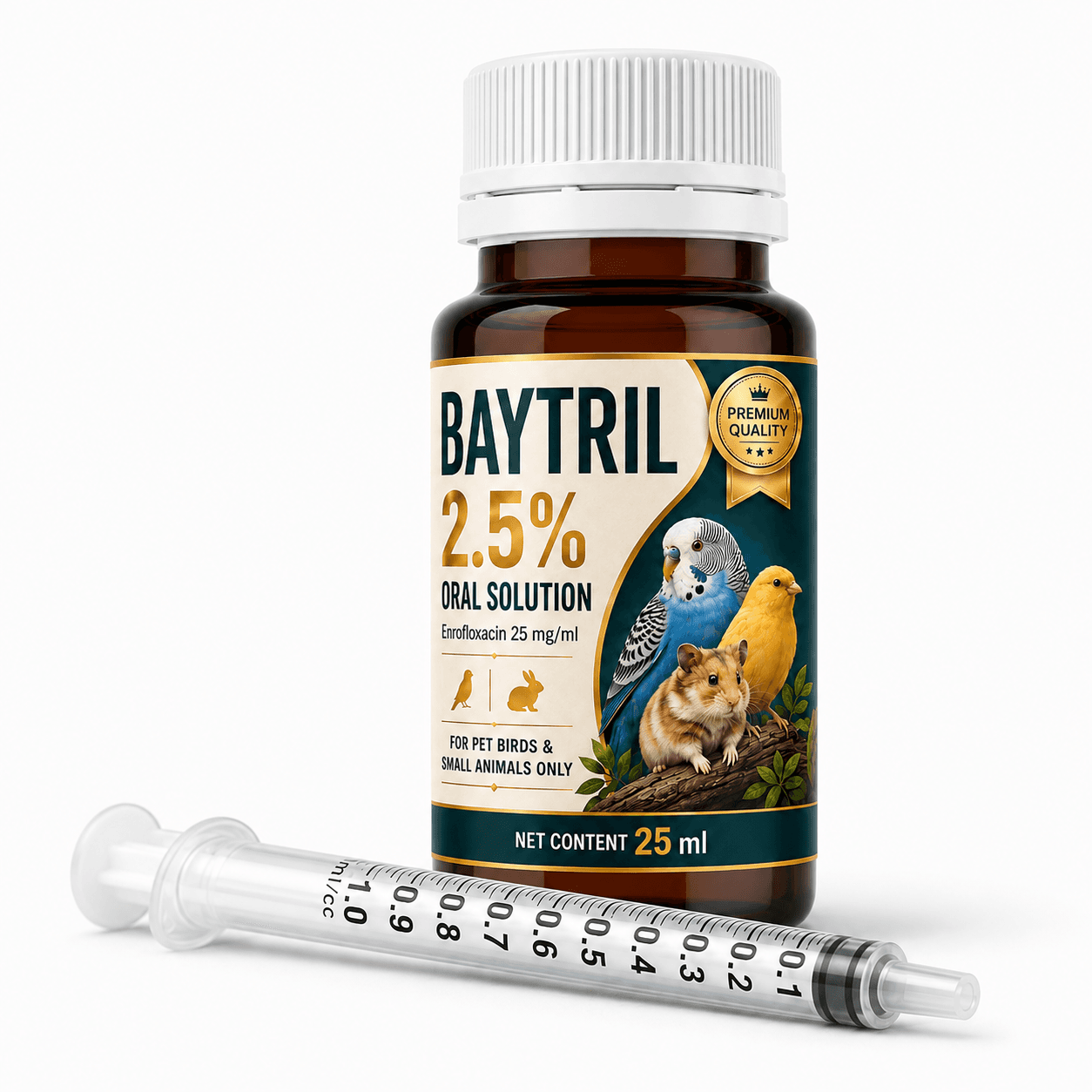
Baytril 2.5% Oral Solution for Pet Birds & Small Animals – Enrofloxacin 25 mg/mL – 25 mL
by My Fish Mox · Sealed, factory-direct stock · Lot-coded
Ships today — checking cut-off…
Bundle & save
- Buy 2 or more — $27.95 each (save $1 a bottle)
- Buy 5 or more — $25.95 each (save $3 a bottle)
Applied automatically at checkout. Mix any bottles in the range — the count is across your whole cart.
Dispatched the same business day on orders before 2:00 PM ET
Factory-sealed bottle, lot code and expiry printed on the label
30-day returns on unopened, sealed bottles
For aquarium and avian use only. Not for human consumption. See the treatment guide before dosing.
Shipping & delivery
Orders placed before 2:00 PM ET on a business day are dispatched the same day from our US warehouse; later orders, weekends and holidays go out the next business day. Every order ships tracked within the United States and you get the tracking number by email. Full terms in our shipping policy.
Returns
Unopened, factory-sealed bottles can be returned within 30 days of delivery. For safety reasons opened bottles cannot be returned. Damaged or incorrect items are replaced or refunded in full — see the refund & return policy.
What is in the bottle
One active ingredient at the strength and count printed on the label, sourced against USP specifications. The bottle arrives factory-sealed with its lot code and expiry date on the label, and we do not ship stock within twelve months of expiry.
Storage & handling
Keep bottles sealed, dry and out of direct sunlight at room temperature, and out of reach of children and pets. Dispose of expired product through a pharmacy take-back programme rather than down the drain.
Baytril 2.5% Oral Solution for Pet Birds & Small Animals (Enrofloxacin 25 mg/mL, 25 mL)
A small bird that has stopped eating, or a pet rodent or rabbit that has gone quiet, can deteriorate quickly. When an avian veterinarian identifies a susceptible bacterial infection and chooses enrofloxacin, the question becomes how to give an accurate dose to a very small animal. That is what this bottle and its syringe are for.
Baytril 2.5% Oral Solution contains enrofloxacin at 25 mg per millilitre in a 25 mL bottle, and the pack is labelled for pet birds and small animals. Enrofloxacin is a bactericidal fluoroquinolone, strongest against gram-negative bacteria such as E. coli, Salmonella and Pasteurella, and also active against Mycoplasma.
This is the more dilute of the two Baytril solutions we stock, and that is its purpose: at 25 mg per millilitre a small bird's dose comes out as a volume a syringe can actually measure. Where a larger animal is being treated, the Baytril 10% Oral Solution gives the same dose in a quarter of the liquid. The two are not interchangeable millilitre for millilitre.
Important Notice: this product is for pet birds and small animals as stated on its label. It is not for human use and not for poultry or other food-producing birds. Always consult a qualified veterinarian if you are unsure about diagnosis or treatment.
What Is Baytril 2.5% Oral Solution?
Baytril 2.5% Oral Solution is a ready-mixed liquid antibiotic supplied with a graduated dosing syringe. The label states enrofloxacin 25 mg/ml, a net content of 25 mL, and that it is for pet birds and small animals only.
Baytril is the brand name printed on this pack; enrofloxacin is the active ingredient. Because it is a solution rather than a powder, it can be measured in fractions of a millilitre for one animal, which is the point of the format.
Enrofloxacin is bactericidal: it inhibits bacterial DNA gyrase and topoisomerase IV, stopping DNA replication so susceptible bacteria die.
Product Details at a Glance
| Attribute | Details |
|---|---|
| Active ingredient | Enrofloxacin |
| Concentration | 25 mg per mL (2.5%) |
| Drug class | Fluoroquinolone antibiotic |
| Mechanism | Bactericidal; inhibits DNA gyrase and topoisomerase IV |
| Formulation | Ready-mixed oral solution, supplied with a dosing syringe |
| Net content | 25 mL |
| Labelled for | Pet birds and small animals only |
| Spectrum | Strongest against gram-negative bacteria including E. coli, Salmonella and Pasteurella; also Mycoplasma; limited anaerobic activity |
| Regulatory status (USA) | Supplied over the counter for pet birds and small animals. Not an FDA-approved animal drug, and extra-label fluoroquinolone use in food-producing animals is prohibited — see our legal and regulatory information |
| Storage | Cool, dry place out of direct sunlight; keep away from children |
What Baytril 2.5% Oral Solution Is Used For
This solution is intended for susceptible bacterial conditions, particularly the gram-negative organisms below. Signs overlap between conditions, so the diagnosis has to come from a veterinarian rather than from a symptom list.
Colibacillosis
Associated with Escherichia coli. A bird may be lethargic and fluffed up, have diarrhoea and sometimes respiratory signs. E. coli is among the gram-negative bacteria enrofloxacin covers, but those signs do not identify it without veterinary assessment.
Salmonellosis and paratyphoid
Associated with Salmonella species, and a familiar problem in pigeon lofts. Signs include watery or greenish droppings, weight loss, and swollen joints or wing joints. A change in droppings or a swollen joint alone cannot establish the diagnosis.
Pasteurella infections and cat injuries
Associated with Pasteurella multocida, classically after a cat bite or scratch. Enrofloxacin's spectrum includes Pasteurella, but a cat-injured bird needs immediate veterinary care, not a home course.
Bacterial respiratory infections
Sneezing, nasal discharge or laboured breathing may prompt investigation. Mycoplasma is within the spectrum, as are gram-negative bacteria. Respiratory signs have many causes, so match the product to the assessed organism — our guide to the antibacterial classes explains how the classes differ.
How Does Baytril 2.5% Oral Solution Work?
Enrofloxacin kills susceptible bacteria by inhibiting DNA gyrase and topoisomerase IV, stopping bacterial DNA replication. Its strongest activity is against gram-negative bacteria, with additional Mycoplasma activity and limited anaerobic activity.
At 25 mg per millilitre, precision matters: a tenth of a millilitre carries 2.5 mg. That is why the bottle ships with a graduated syringe rather than a dropper.
Baytril 2.5% Oral Solution Dosage and Administration
The label states the concentration and the volume. It does not state a dose per animal, and neither do we — a liquid is dosed by body weight, and the animals this bottle covers range from a finch to a rabbit.
| What the label states | Value |
|---|---|
| Concentration | Enrofloxacin 25 mg per mL (2.5%) |
| Net content | 25 mL |
| Supplied with | A graduated dosing syringe |
| Dose per bird | Not printed on the label — set by an avian veterinarian |
Why we do not publish a dose for this bottle. A liquid is dosed by the individual bird's body weight, and a budgerigar, a pigeon and a macaw differ by orders of magnitude. The bottle prints its concentration so a veterinarian can calculate from it; it does not print a figure you can apply to your bird without that calculation. Ask your avian veterinarian for the volume, the frequency and the number of days, and write it down.
Measuring accurately
Use the syringe supplied. At 25 mg per millilitre, 0.1 mL is 2.5 mg of antibiotic — a meaningful amount for an animal weighing tens of grams. Have your veterinarian give you the volume in millilitres for your animal's weight, write it down, and keep the bottle so the concentration can be checked later.
Safety, Side Effects, and Precautions
Fluoroquinolone stewardship
Fluoroquinolones are among the antibiotics human and veterinary medicine most need to keep working. Use enrofloxacin only for a confirmed or strongly suspected bacterial infection, at the dose your veterinarian sets, for the full course. A broad spectrum is a reason to be more careful, not less.
Never combine two enrofloxacin products
This solution and our Enrofloxacin 10% Powder contain the same active. Running both at once doubles the dose without anyone intending it. Use one product, finish the course, then reassess with your veterinarian.
Not for food-producing birds
US rules prohibit extra-label fluoroquinolone use in food-producing animals. Do not use this product in chickens, ducks, quail or turkeys kept for eggs or meat, and do not apply anything on this page to a food-producing flock. See our legal and regulatory information.
Mineral binding
Calcium, magnesium and iron reduce enrofloxacin absorption. Remove mineral blocks, cuttlebone, grit and mineral supplements during treatment, and confirm any dietary change with an avian veterinarian.
Cat bites and scratches are an emergency
Pasteurella from a cat's mouth causes sudden, severe illness in birds. The puncture wounds are often tiny and hidden under feathers. Get immediate veterinary care rather than starting a course at home and waiting to see what happens.
Not effective against fungi, viruses or parasites
Enrofloxacin is an antibiotic with limited activity against anaerobic bacteria and none against fungi, viruses or parasites. A bird with diarrhoea or respiratory signs may have a cause outside its spectrum, which is why the diagnosis has to come first.
Storage and Shelf Life
Store the bottle in a cool, dry place out of direct sunlight and keep it away from children. Check the lot number and expiry date printed on the pack before use. Keep the cap closed and the syringe clean between doses.
Baytril 2.5% Oral Solution vs. Our Other Bird Medications
Enrofloxacin comes in several strengths and formats in our range. Baytril 2.5% is 25 mg per millilitre; do not assume a volume from one product transfers to another.
| Product | Active ingredient | Strength | Best for | When to choose |
|---|---|---|---|---|
| Baytril 2.5% Oral Solution (this product) | Enrofloxacin | 25 mg per mL | The gram-negative targets above | Accurate dosing of an individual bird or small animal |
| Enrofloxacin 10% Powder | Enrofloxacin | 100 mg per gram | E. coli, Salmonella, Pasteurella, gram-negative infections | Flock or loft treatment through drinking water |
| Tylosin Powder | Tylosin tartrate | 99% (990 mg per gram) | Mycoplasma, chronic respiratory disease, sinusitis | Respiratory signs where Mycoplasma is suspected |
| Doxycycline 20% Powder | Doxycycline | 200 mg per gram | Psittacosis, Mycoplasma, bacterial respiratory infections | Suspected psittacosis |
| Doxy-Tyl Powder | Tylosin + doxycycline | 40% + 20% | Mixed respiratory infections, Chlamydia + Mycoplasma | When both organisms may be involved |
| Vetafarm Trizole | Combination antiprotozoal | See pack | Canker, coccidiosis, giardia, hexamita | Protozoal problems, which antibiotics do not cover |
| Amoxicillin 10% Powder | Amoxicillin | 10% | Susceptible bacterial infections | When a vet indicates a beta-lactam |
Our recommendation: Get a diagnosis and a dose in millilitres from your veterinarian. The two Baytril strengths exist so that a very small bird and a larger animal can both be dosed accurately — check which one you are holding before you draw anything up.
Signs of Recovery and When to Seek Veterinary Help
What Recovery Looks Like
A recovering animal becomes brighter and more active, eats and drinks normally, and passes normal droppings. In birds, breathing becomes quiet without tail bobbing or open-mouth breathing. The label does not state how quickly that should happen.
When to Seek Professional Help
Seek immediate care after a cat bite or scratch, and prompt care for worsening breathing, refusal to eat or drink, or marked lethargy. Arrange reassessment if there is no improvement on a confirmed plan.
Frequently Asked Questions About Baytril 2.5% Oral Solution
These answers cover what the label states, what it does not, and where a veterinarian has to make the call.
What is Baytril 2.5% Oral Solution?
A ready-mixed liquid fluoroquinolone antibiotic containing enrofloxacin at 25 mg per millilitre in a 25 mL bottle, labelled for pet birds and small animals and supplied with a dosing syringe.
How much should I give?
The label states the concentration, not a dose. Liquids are dosed by body weight, so the volume has to come from a veterinarian who has weighed and assessed the animal.
What is the difference between Baytril 2.5% and Baytril 10%?
The concentration. Baytril 2.5% is 25 mg of enrofloxacin per millilitre; Baytril 10% is 100 mg per millilitre — four times stronger. The 2.5% exists so a very small bird can receive an accurate dose in a measurable volume. Never substitute one for the other at the same number of millilitres.
Is this the same as your Enrofloxacin 10% Powder?
The active ingredient is the same but the formulations are not interchangeable. The powder is 100 mg per GRAM and is mixed into drinking water; this is a liquid at 100 mg per MILLILITRE. Never carry a dose from one to the other.
What should I do if a cat bites or scratches my bird?
Get immediate avian veterinary care. Pasteurella from a cat's mouth can cause sudden, severe illness, and the puncture wounds are often tiny and hidden under feathers. Do not wait to see whether symptoms develop.
Should I remove mineral blocks during treatment?
Yes. Calcium, magnesium and iron bind enrofloxacin and reduce absorption, so remove mineral blocks, cuttlebone, grit and mineral supplements during the course, and confirm the bird's nutritional plan with your veterinarian.
Can this be used for chickens or other poultry?
No. US rules prohibit extra-label fluoroquinolone use in food-producing animals, and the label is for pet birds. That includes chickens, ducks, quail and turkeys kept for eggs or meat.
What if my bird will not take it?
Contact an avian veterinarian promptly. A bird that refuses a medication, or that is too unwell to swallow, needs a different route rather than a larger dose.
Can I use it for a rabbit, hamster or guinea pig?
The pack is labelled for pet birds and small animals. Species differ in how they tolerate antibiotics — some small herbivores are particularly sensitive to gut flora disruption — so confirm suitability with a veterinarian who treats that species before giving anything.
Conclusion
Baytril 2.5% Oral Solution supplies enrofloxacin at 25 mg per millilitre in a 25 mL bottle with a dosing syringe, labelled for pet birds and small animals. Its bactericidal fluoroquinolone action covers susceptible gram-negative bacteria and Mycoplasma.
Use it only on a veterinary diagnosis and a veterinary dose measured with the syringe. Check which strength you are holding, never run it alongside another enrofloxacin product, and treat a cat bite or scratch as an emergency.
Ready to treat? Baytril 2.5% Oral Solution, enrofloxacin 25 mg/mL, 25 mL with syringe is in stock and dispatched the same business day on orders placed before 2:00 PM ET, shipped tracked within the United States.
Related Products
These products have related or complementary roles.
- Enrofloxacin 10% Powder — the same active for drinking-water treatment of a loft.
- Tylosin Powder — for suspected Mycoplasma-related respiratory signs.
- Terramycin Eye Ointment — for a topical eye problem rather than a systemic infection.
- Browse all bird antibiotics or read our guide to the antibacterial classes.
External Resources
Use these veterinary resources alongside advice for your individual bird.
- Association of Avian Veterinarians (AAV)
- American Veterinary Medical Association (AVMA)
- Merck Veterinary Manual
- FDA Center for Veterinary Medicine
Disclaimer: This page is general husbandry information, not veterinary advice and not a dosing instruction. This product is intended exclusively for the animals named on its label. It is not for human consumption and not for poultry or other food-producing birds. Consult a qualified avian veterinarian for diagnosis and treatment.